
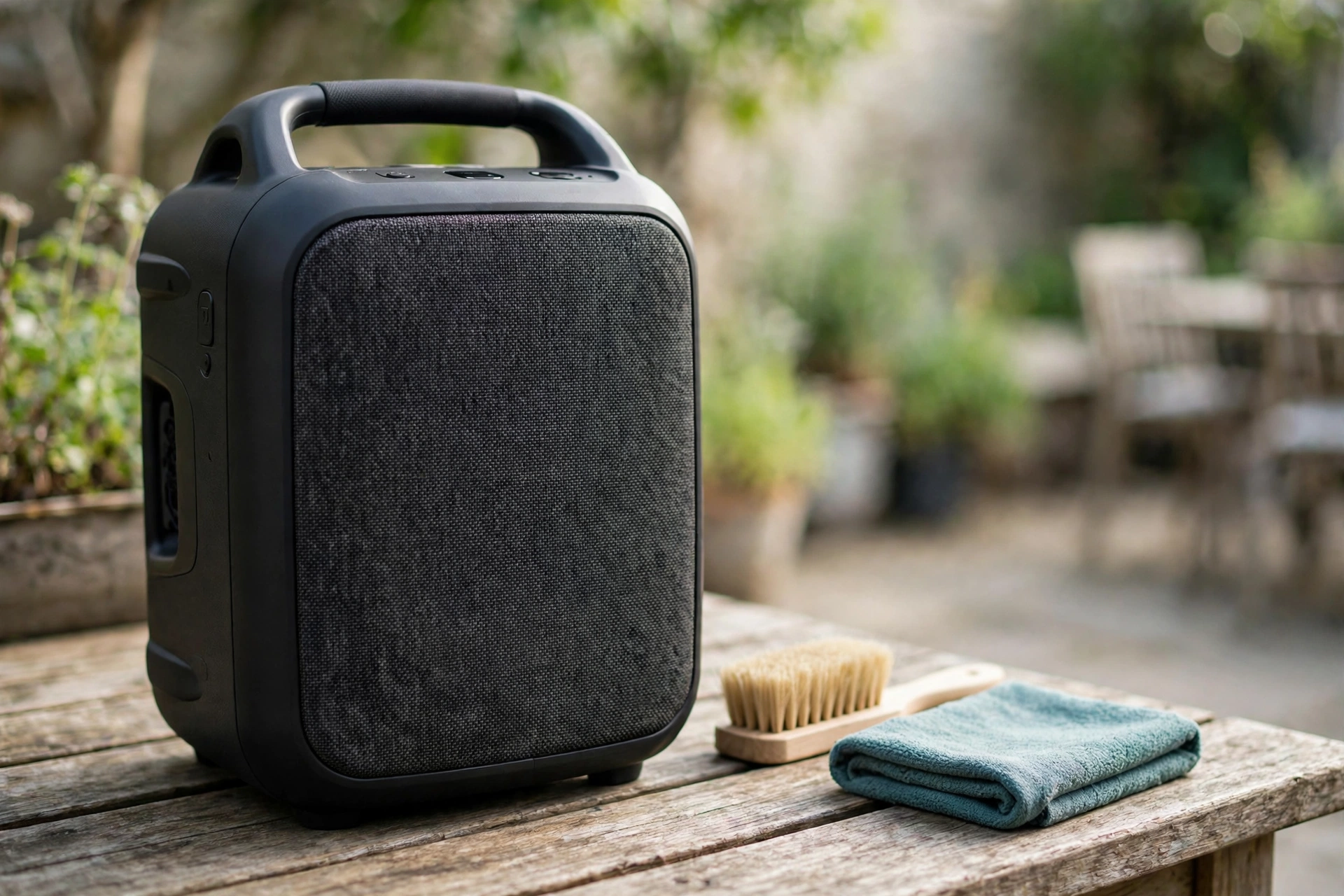
How to Clean a Bluetooth Party Speaker Safely
Yes, you can clean a Bluetooth party speaker safely at home. Switch it off and unplug it, work dry before you work damp, match the method to the grille type and the water rating, and let it dry fully before charging. The two costliest mistakes are wetting dust before removing it, and assuming a waterproof rating means the speaker can be rinsed.
Before You Touch a Cloth: Check the Rating and the Grille
Every safe clean starts with two facts about your own speaker: its water rating, and whether its grille comes off. Find the rating on the box or in the manual. The rating is the second digit after IP — the first covers dust, the second covers water — and it describes a laboratory test in fresh water, with every cover closed.
| Water rating | What the test means | What it allows when cleaning | What it still forbids |
|---|---|---|---|
| No rating | No water protection tested | Dry cleaning only | Any wet cloth or rinse |
| IPX3 | Sprayed water, briefly | A barely damp cloth | Rinsing or soaking |
| IPX4–IPX6 | Splashes and water jets | A barely damp cloth | Submersion |
| IPX7 | Immersion, 1 metre, 30 minutes | Rinsing only if the manual allows it | Salt water, charging while damp |
Two warnings belong with that table. First, a rating only holds with every cover in place. Sony states this plainly for its LF-S50G: when the speaker grille is removed, the speaker does not satisfy its IPX3 water resistant specification. Second, ratings are tested with fresh water, not pool water or seawater. Now the grille check: fabric or metal, fixed or removable — and does the manual describe removing it? If it does not, the grille stays on — prying a fixed grille breaks clips and dents the driver behind it.
How to Clean a Bluetooth Party Speaker by Grille Type
A fabric-covered box, a steel-grille tower, and a speaker with a pop-off front panel are three different cleaning jobs. Find your row below.
| Grille type | Dry step first | Damp step | Never do this |
|---|---|---|---|
| Fixed fabric | Vacuum on low suction, then lint roller | Dab with a barely damp cloth | Soak, scrub, or spray the fabric |
| Removable fabric | Lint roller on both sides, soft brush | Wash only if allowed | Refit while damp |
| Fixed metal | Soft brush, short air bursts | Wipe with a barely damp cloth | Push a brush through the holes |
| Removable metal | Brush and wipe both sides once off | Wash only if allowed | Force clips, refit it wet |
Dry first, always: dry dust brushes away, but wet dust turns to paste in the weave.
Power Off and Unplug First
Switch the speaker off, pull out the charging cable and any aux cable, and if the battery slides out, take it out too. A speaker that looks off can still short if moisture reaches the charging contacts.
Cleaning a Fabric Grille Without Pushing Dirt In
Fabric is the most common party speaker grille, and the most easily ruined. Start with the grille facing down, so gravity works with you. Run the vacuum brush attachment over the fabric on low suction, holding the nozzle just off the surface. Work top down, then follow with the lint roller.
For a mark or a sticky patch, dab — do not rub. Dampen a corner of a microfibre cloth with plain water, wring it until it feels almost dry, press it lightly onto the mark, and lift. If the mark is greasy, a drop of mild dish soap on the damp cloth is the strongest thing to try, if your manual allows soap.
Ultimate Ears gives the clearest example of how a fabric grille is meant to be treated: make sure the speaker is turned off, moisten the fabric acoustic skin with a water wand or spray bottle, wet a soft-bristle brush with soapy water and lightly scrub the skin, then quickly rinse the soap off or wipe with a damp cloth, and allow the speaker to air dry completely before charging it. The same company also says to rinse the speaker with fresh water after using it in a swimming pool or the ocean.
Cleaning a Metal or Perforated Grille
A metal grille forgives more than fabric, but it hides its damage better. Brush first, with a dry soft brush, sweeping across the holes so dust falls out. If your manual allows compressed air, hold the can upright and level, at least a hand’s width from the grille, and use short bursts. Tilt the can and you can spray freezing propellant onto the driver behind the grille. Never aim compressed air into a port or at a driver cone.
Then wipe. Dampen a microfibre cloth with plain water, wring it until barely damp, and wipe the metal in one direction. For sticky residue, a little 70% isopropyl alcohol on the cloth is acceptable, if your manual allows it — but put the alcohol on the cloth, never on the speaker, and keep it away from rubber seals and logos, which it can dull. Dry the grille straight away with the second cloth.
If the Grille Comes Off: What Sony, SOUNDBOKS and Marshall Actually Say
A removable grille is a gift only when the maker designed it to come off. Three brands show how different the rules are — and why your own manual beats any general guide.
Sony’s LF-S50G is the classic case. Sony’s help guide says the grille twists off counterclockwise until it clicks, then lifts away, and washes under running tap water. The same guide sets three hard limits: no soapy water or hot water, no scrubbing, and no IPX3 protection while the grille is off. Twist off, rinse in plain tap water, dry the grille, and refit it.
SOUNDBOKS takes a different route. The SOUNDBOKS 4 grille is a powder-coated steel panel held by a snap-fit fastener, and the manual says to remove it with the included Grill Removal Tool — a handle with a rubberised tip that hooks into the grille holes. The manual’s cleaning advice is plain: wipe the exterior with a soft, dry cloth, and keep moisture out of openings. Because the SOUNDBOKS 4 runs on a removable BATTERYBOKS battery, slide the battery out before any damp cleaning, and never plug the charger in without the battery in place.
Marshall draws the line in yet another place. Marshall’s guidance for the Bromley 450 allows a lint-free cloth slightly damp with water, or with 70% isopropyl or 75% ethyl alcohol — but it rules out compressed air, bleach and hydrogen peroxide products, and running water. Compressed air, rinsing, and alcohol are model-specific permissions, not general rights. If your manual is silent on a method, treat that method as not allowed.
The Cabinet, Handles and Buttons
Wipe the cabinet with the barely damp cloth, top down, and dry it at once. Wipe buttons with the dry cloth first — never let liquid pool around a button edge.
Ports, Charging Flaps and the Dry-Before-You-Charge Rule
Ports are where cleaning accidents turn into repair bills. Clean them dry, and only dry. Shine the torch into each port first. If you see dust, use the dry soft brush with the lightest strokes across the opening, never pushing inwards. If you see grit, a short burst of compressed air from a distance, aimed across the opening, can clear it — but only if your manual allows compressed air at all.
Close every flap and cover before any damp work, and check the seal while you are there. A flap with a torn edge, a cracked seal, or grit in its groove is no longer a seal, and a speaker with a failed flap should be treated as having no water rating until the flap is replaced. Wipe the flap, dry it, then press it closed.
The rule is absolute: dry fully before charging. Water plus a charging cable corrodes contacts, trips protection circuits, and can damage the battery. After any damp cleaning, leave the speaker grille-down on a towel in a ventilated room, flaps open, for a few hours — overnight if the grille is fabric or the speaker was rinsed. Do not use a hair dryer, do not put it in sunlight, and do not plug it in “just to check” while it is still damp. The grille should feel dry, and the ports should look dry under the torch.
Spills, Sand and Pool Water: Three Messes, Three Responses
A spilled drink comes first. Switch the speaker off immediately and unplug it. Turn it so the spill runs away from the ports and grille, and blot the liquid with a dry cloth. Wiping spreads a sugary drink across the grille and into the seams; blotting lifts it. If the drink went into a port, do not charge the speaker, do not play it, and give it a full day to dry.
Sand is the second mess, and the rule is: never add water to it. Wet sand becomes grit paste, which is almost impossible to remove from a fabric grille without damaging the weave. Hold the speaker grille-down and tap the back firmly with your knuckles. Brush the grille with the dry soft brush, sweeping downwards, and vacuum on low suction. Repeat until no more sand falls out. If sand has gone into a port, use the dry brush and short bursts of compressed air — never a wet cloth, never a pin, and never your breath.
Pool water and seawater are the third mess, and the most urgent. Chlorine and salt keep working after the speaker looks dry, corroding contacts and stiffening fabric. If your speaker’s rating and manual allow rinsing, rinse it in fresh water as the manual directs, then dry it completely before charging. If your speaker is not rated for rinsing, wipe every wet surface with a cloth dampened in fresh water, then dry it and leave it open to air-dry for hours. Check the charging port twice — salt residue there is the most common cause of a speaker that survives the pool and dies at the next charge.
What Never to Use on a Party Speaker
Kitchen sprays and multi-surface cleaners contain solvents that attack rubber seals and leave a film on fabric. Glass cleaner contains ammonia, which dulls plastic. Bleach and hydrogen peroxide products discolour fabric and degrade rubber — Marshall’s guidance rules them out explicitly. Paper towels shed fibres into the grille and scratch glossy plastic. Abrasive pads and stiff brushes tear fabric weave and scuff metal. A dishwasher combines heat, detergent, and pressure — and destroys speakers. Compressed air aimed into a driver or a port can dent a cone or drive grit deeper. Soap belongs only on a removable fabric part the manual says is washable — never on a fixed grille or in a port.
Tested on: Check the Sound After Cleaning
Cleaning is only finished when the speaker sounds right. Run this check after the speaker is fully dry, cable unplugged.
First, play a track you know well — clear vocal, bass line, and high-hat — at low volume, then at your normal party volume. The free speaker test tool at myspeakerfix.com plays test tones in your browser, and a steady tone makes distortion easier to hear than a song does. Pass if the sound is clear at both volumes, with no buzz, rattle, or crackle. Fail if you hear buzzing at low volume — stop and let the speaker dry longer.
Second, check each driver separately. Play a bass-heavy track: pass if the bass is full and even, fail if it sounds thin, rattly, or one-sided. Then play a vocal track: pass if voices are clear, fail if the treble sounds muffled — the grille is usually still damp.
Third, check the charging port is dry. Shine the torch into the port and look for moisture, residue, or corrosion. Pass if the port is clean and dry, the cable seats fully, and the charging light behaves normally. Fail if you see moisture, green or white residue, or the cable feels loose — do not charge it; dry it longer, and if the residue remains, take it to a repair shop. If all three checks pass, the speaker is ready.
Frequently Asked Questions
Can I rinse my Bluetooth party speaker under a tap?
Only if your manual says so. Some speakers, like the Sony LF-S50G, allow the removable grille alone to be rinsed in plain tap water. Most should never be rinsed — use a barely damp cloth instead.
How do I clean a fabric speaker grille without ruining it?
Work dry first: vacuum on low suction, then use a lint roller. Dab marks with a barely damp cloth, and let the fabric air-dry fully. Never soak fixed fabric, and never refit a removable grille while damp.
Can I use compressed air on my party speaker?
It depends on the brand. Some makers allow short bursts with the can held level, while Marshall’s guidance for the Bromley 450 rules compressed air out entirely. Check your manual first, and never aim air into a driver, a port, or a charging socket.
How long should a party speaker dry before I charge it?
A few hours after damp cleaning; overnight if the grille is fabric or the speaker was rinsed. Leave the flaps open in a ventilated room, and check the charging port is dry before plugging in. Charging a damp speaker can corrode the contacts and damage the battery.
Related Guides
Clean it dry first, match the method to the grille and the rating, and dry it fully before charging. If the sound is still muffled after a clean and a full dry, run the free test tones at myspeakerfix.com.